A Cat Pal's Guide to Cat Things
Updated: Mar 16
I love cats. I've had cats my whole life, and I've done my best to learn how cats like to be treated. Obviously, all cats are different, so the most important thing is to spend time with your cat and listen to what they're telling you with their body language and behavior. That said, here are some items, routines, and suggestions I have that are kitty-approved.
Disclaimers!
I am not a vet. I'll talk a bit about some of my preferred cat foods, litter, etc., but do your own research and consult with your vet.
None of the links below are affiliate links. There are just some products that I feel I can vouch for, no kickback necessary. I'll also describe and name items (to the best of my ability), so you can search for relevant items without links as well.
The below categories are in no particular order.
Environmental Enrichment
One of the most important (and overlooked) ways to improve your cat's quality of life is to provide environmental enrichment. Cats can get bored, leading to behavioral issues. Cats can get depressed. Cats can gain weight when they are overly sedentary, potentially leading to health issues.
Playing with your cat is important, and I'll recommend some cool toys later, but let's step back and consider the environment when you're unavailable. Your cat should always have access to things that will keep them mentally stimulated.
Cat trees
Aside from providing a place for your cat to lounge, cat trees are an important way to give cats 1) vertical mobility, 2) something to scratch, 3) a scent marker.
Most environmental enrichment comes down to trying to emulate outside conditions for your indoor cat. Cats like to climb; to relegate them to the floor is limiting. Giving them something to climb is a benefit to them, and might just keep them from jumping up in other places they shouldn't be. Each cat has a preferred height. Getting a taller cat tree can help you notice where your cat tends to hover. You can then try to find ways to incorporate more perching places at that level around the house.
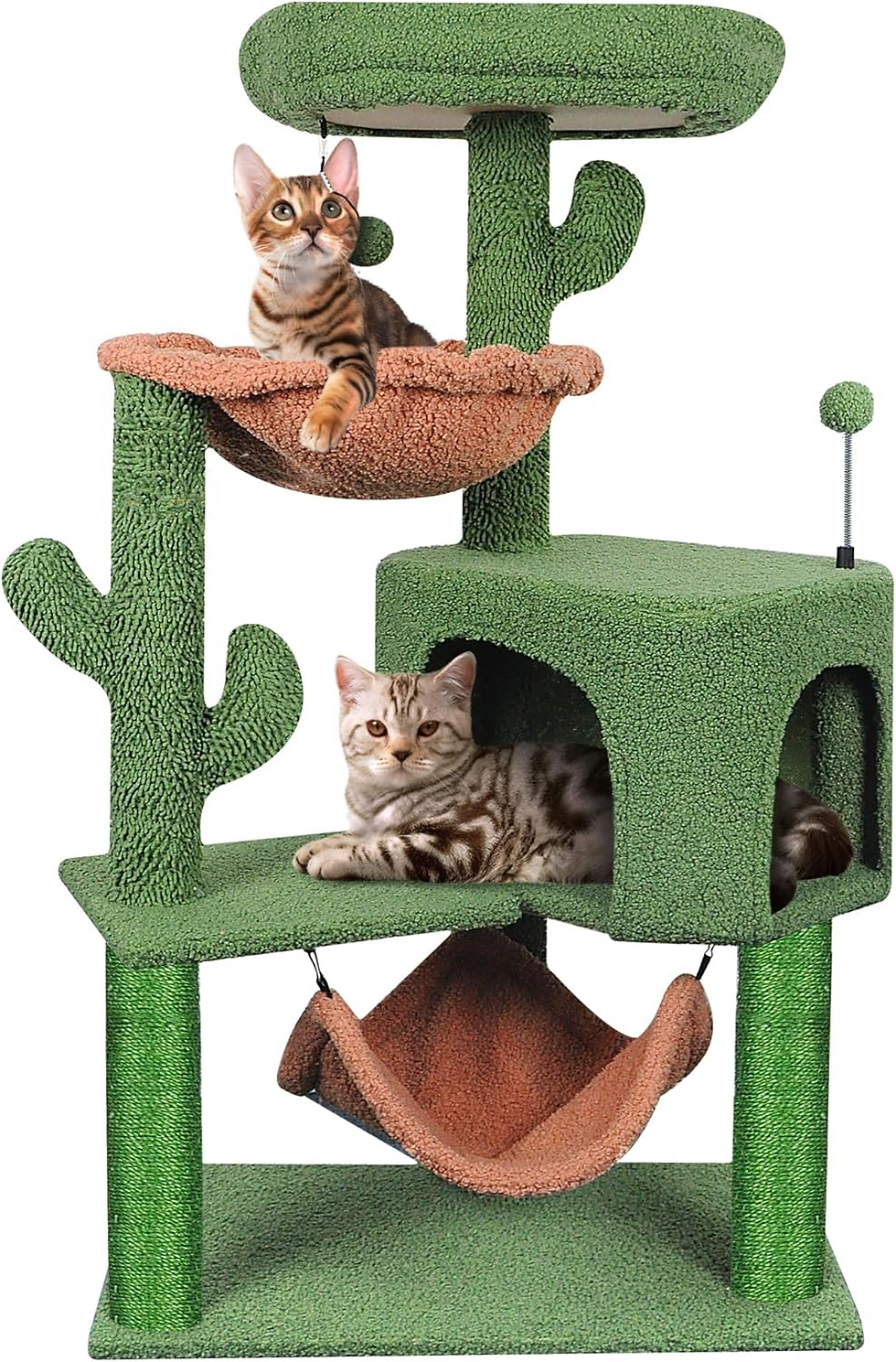
Cat trees will almost always have sisal rope or a scratching board element toward the bottom. Most cats like to scratch, and you can strategically place a cat tree next to sofas or other items you don't want scratched—that way they'll go for the cat tree instead. Scratching and sleeping on the cat tree also marks their scent, which marks their territory and leaves them feeling safer and more confident; cat trees and beds should be spread throughout the house to mark their scent (and keep them from doing so in other ways, like spraying or being aggressive with other animals).
This (above) is the latest cat tree I've purchased. Most cat trees will incorporate different elements like a flat bed, a condo (box portion), a bowl, and/or a hammock. Choosing a tree with more elements will not only give your cat more variety, but you'll be able to see which elements they prefer, then get more of those elements in the future. For example, my cats tend to rate the elements: hammock<condo<flat bed<bowl.

A note on trees with bowls: because my cats like the bowl element best, I make sure every cat tree has one. However, it can be harder to find cat trees that adequately support the bowl on two sides. I don't personally recommend cat trees which have the bowl to one side, as shown here. This was the first cat tree with a bowl I purchased. The cats loved the bowl, but with frequent use, it broke. Bowls are going to be made of a metal ring and loose fabric. When off to one side like this, the bowl is supported by another metal ring around the "arm" of the main tree. All of the cat's weight is put on one pressure point. The metal can (and did) snap.
I now make sure that bowls are supported on both sides, so there is no risk of metal snapping (and wasting money!). Below is an example of a small, simple design that has adequate construction.

Cat wheel
A cat wheel is essentially the same as a large hamster wheel. It stays in place so that the cat can run and get out energy. These are great because they don't need electricity, supervision, or (in our case) any coaxing or external reward. Of our cats, we have 1 who is indifferent to the wheel, 1 who likes it just fine, and 1 who is completely obsessed—he hops on the wheel for fun when he's got the zoomies, to get my attention (my work desk is within line of sight), to get out anxious energy, and sometimes for no reason at all. It keeps him entertained, redirects negative energy (and thereby negative behaviors), and gets him a tremendous amount of exercise.
The wheel does take up a fair amount of space, so do some measuring and find a good spot before committing.

This is the wheel I purchased. It's a little over a foot wide and about 4 feet tall. It rolls on casters that are reasonably quiet, though it can definitely be more loud and annoying when the cats seem determined to get upside-down. It was very annoying to put together (I recommend having another person to help), but it has been incredibly worth it.
A note on wheel size: if you're interested in getting a cat wheel, definitely look into the (interior of the) wheel size! A wheel that is too small could potentially be bad for your cat's spine. The more expensive cat wheels will make a note of this and have more information—you can then find cheaper wheels/brands of similar sizes, which is what I did. Better to have a wheel that is too large for your cat than the other way around.
Windows
A free resource! Windows are "cat TV." Whether you're home or not, if your cat has access to a window view, they can access hours of entertainment. Ideally, you'll find a setup to allow access to as many windows as possible. One might be the back of the couch in the living room window. Another window might just need an end table or a strategically placed chair. This would be a great way to place your cat trees.

If you have windows that close up and down (rather than slide left and right), I recommend a window bed like this. There is no drilling/mounting required. The bed itself is a soft fabric which has some give but is relatively taut. If your cat doesn't like a fabric or hammock bed, you could easily set a folded blanket on top (just be sure that if the blanket were to fall and they slipped that they would be okay); some of these beds even have more cushiony bed attachments (you could even work out a way to just tie a more traditional bed onto this one through its legs). This bed is a much-loved spot for looking out onto the yard or just enjoying the sunshine.
I've also got a great bed option for sliding glass doors (or large windows). If the door is closed 99% of the time, that's free real estate! This bed uses several strong suction cups (and comes with some extras). Once every couple of months, the top cups pop off the glass, but you just need to clean them and reapply. It's been very sturdy!

A note on exterior environmental enrichment: consider how to make the view outside even more engaging for your inside cat. The easiest way to do this is with birdfeeders. There's a way to put a birdfeeder out almost no matter what your house or yard setup is. If you don't have a tree, you might have a shed, fence, or something else to install a hook on. If not, there are simple square ground feeders (which I have on the ground and also strapped via bungee cord to our deck). You can also get a cheap pack of free-standing yard hooks which you just poke into the ground. I've also tried a plastic bird feeder that suction-cups onto the window itself (mixed results on that). You could also use flowers to attract pollinators, or even just use a pinwheel for some fun colors and movement.
Automation
I'm all for automation as a way to supplement your cat caregiving. With anything automated, you'll want to test to make sure its safety measures are working before leaving your cat unattended (particularly when it comes to automatic litter boxes). The primary uses for automation for me have been for litter boxes, toys, and water. I haven't used any pet cameras, as I work from home.
Automatic litter box
Automatic litter boxes are a mixed bag, and require a lot of research. When you search for an automatic litter box, results coming back will be 1) non-automatic boxes with a pee tray, 2) non-automatic boxes to manually tumble, 3) open-top boxes with an automatic rake, 4) enclosed boxes with an automatic rake, and 5) boxes that automatically tumble.

Option 1 (non-automatic box with a pee tray) would be something like the Breeze litter system. You use pellet litter. Poop stays on top, and pee goes through the holes in the bottom, into a tray below, where you place an absorbent pee pad. Obviously this is not an automated system, but it still frequently pops up in search results when looking for an automatic litter box. The appeal to this system is that you don't have to scoop as often, and the pellet litter does not track (much) and is not dusty. Here's why I did not like this system. Above all else, the point of an upgraded litter box—for me—is to think about the litter as little as possible. That's partly because the litter is not a fun chore to do, but also because, historically, I'm just really, really bad at remembering to do the litter. With this kind of litter box, the consequences of forgetting the litter are high. You will end up with an overflowing pee tray, and the interior/underbelly of the litter box is a pain to clean. Another drawback is the expense of the name-brand system. I'd recommend finding off-brand replacements for the litter and pee pads. Just be sure that any other pellet litter you find is going to maintain its shape when wet, not crumble into powder (as many cedar pellets do).

Option 2 (non-automatic box to manually tumble) may also appear in your search results, despite not being automatic. This kind of box uses the same idea as an automatic tumbler litter box: up on the side of the interior is a filter that will catch solid waste but let clean litter pass through. The waste is collected in a waste compartment for you to toss out. Theoretically, you won't be scooping litter, just adding new litter as needed and emptying the waste bin. But because this litter box is not electronic or automatic, you must do the tumbling yourself; you literally roll the entire box on its side, then roll it back. I have not experimented with this style of box, because it seems like just as much effort as scooping (if anything, more annoying, because you need to have space to roll the box, and it's much heavier than just emptying a box one scoop at a time. So this seems silly to me, but if it interests you, you'll probably want a non-sticky litter, like the Arm & Hammer Slide formula.

Option 3 (open-top box with an automatic rake) is the lowest entry-level automatic box. Again, I have not experimented with this style of box, and here's why. From my research, many reviews of this style of box complain that the rake is too flimsy, breaks easily, or gets gunked up with waste. I'm also skeptical of the waste bin capacity, with the boxes being on the smaller side. Also, most of these boxes are going to cost over $120, and I believe you can get a decent enclosed automatic box for $200. My experience so far has been with boxes more in the $350-$450 range, but I do believe that you can find something decent for $200 that will far outperform an open-top system (especially if you find someone reselling them!).

Option 4 (enclosed box with an automatic rake) is where my true experience lies. After many hours of research, I picked a model. After a solid 2 years of use, I wanted to add another box, so I went searching for the same model to repurchase. Turns out that the litter box I had chosen was one where the model/patent is sort of passed around from company to company, where if the product ends up with too many negative reviews on Amazon, it will cease to exist under that brand name, then pop up under another one. This sounds super sketchy, and it's not not, but I did many hours of research, and I was in those review sections, learning how to avoid certain product pitfalls, or disagreeing with certain reviews based on my experience with the initial product I'd had for 2 years. In the end, I'd say be wary of any and all automatic litter boxes, because people seem to have major disagreements. I followed this exact design from brand to brand, purchasing it three times, because I was so impressed with my initial purchase. The first one I bought was under the name Hillpig, and it lasted about 3 years before any issue. The current issue is with the door motor. When functional, the door of the box will close before the rake cycles through. My litter box door will start to close, but it won't close all the way, so the rake will make contact, alerting the litter box and shutting the cycle down. There's probably a way to fix this, but it's beyond my abilities. The second box was under the name ELS PET, and it lasted 1.5-2 years before any issue. The current issue—I think—is a sensor issue. It gives an error and will not run the rake cycle. I may be able to clean a sensor and resolve this, but in the meantime, because the first one (which sits right next to it) is down, I've just got them both unplugged and have been scooping them manually. I purchased a third box when we adopted two more cats. This one was under the name KungFuPet, and I've had it for about a year and a half with no issue. I'm mostly happy with the value I've gotten out of these. If you look at it in cents per day, I'd say the cost to not scoop has been worth it for me. Given that my second box had a shorter lifespan (possibly only half of the first—I can't quite remember), I do worry about potentially decreased quality as the model gets passed around between random brands. Time will tell if the latest box holds up.
EDIT: I SEEM TO HAVE BOTH OF THE OLDER MODELS WORKING. Here's what I did to fix them (for the time being). For the oldest one, with the rake/door issue, I first replaced the rake, which had probably gotten misaligned. There were instructions in the manual on how to do that, and the system had come with an extra rake. The manual mentioned "rake sensors"—I didn't know where exactly those were, but I cleaned just about everywhere, including the underside of the waste bin (inside the box itself), where the rake rests when not in use. It was then I noticed that a buildup of litter was sitting on a little lip on the back of the box, which may or may not have been in the way of the rake, so I cleared that off. I've run the cleaning cycle a few times now, and the rake is cycling as it should, not obstructing the door at all, so all seems good! If it continues to work properly, this will mean I have not yet hit the maximum lifespan for this product. For the second box, it does seem to have been a sensor issue; there was an obvious buildup totally covering one of the sensors. After cleaning, it appears to be functioning as it should! Y'all, I'm so delighted I put off purchasing another box for now.

Now, as far as notes on this model (which will likely apply to similar models as well)... The waste bin capacity met my needs just fine. If you have more cats, it will fill more quickly, but that's mitigated if you have multiple boxes. With one box, you'll just need to empty the bin every 3-5 days instead of every 7-10 days, for instance. The box will come with special waste bin liners, and you can get replacements online. You CAN use plastic grocery bags for this model. They're just slightly finicky, and you'll need to be careful that the handles of the bag don't stick into the interior of the box, where they'll snag the rake. I ended up finding it easier to just get a bulk purchase of the liners intended for the system. I recommend getting a lightweight litter to lessen the strain on the rake. The plastic spindles of the rake can snap, which will obviously make the rake (and scooping) less effective. To protect the rake, make sure that the waste bin (and flap in front of it) are where they should be, so the rake doesn't run into anything and get misaligned. The litter box did come with an extra rake.

Lightweight litter will put less strain on the rake, and by extension, the rake motor. I recommend getting one of those big plastic totes of litter with a lid that lifts open on top; the entryway of this litter box model faces directly forward, and there is no way to pour litter in from above. It's easiest to get one of these litter totes and use a scoop (like an old measuring cup or a Tupperware container missing its lid) to refill the box. Be sure you don't overfill with litter—there's a MAX FILL line on the back of the box. Over time I've switched to cheaper litter, which I continue to dump into these totes for ease of use.
This model does have an app, but I find it mostly useless. The litter box has a scale in it just to make sure there isn't a cat inside before running the rake cycle; it does not track your cat's weight. It does not differentiate between multiple cats. It does not track poop versus pee, it just marks the time/duration of visits. It can "tell" you when the litter is low, but not really—you tell it when you've just filled the box, and then it reminds you to fill it after a certain amount of time has passed. The app is not necessary, and internet connection/wi-fi is not necessary. To me, this is a plus, because I don't need more apps/reminders on my phone.
I may or may not go with another model next time (see EDIT above). If I go with another model, one thing I'll be looking for is longevity in the market. For example, this model has been on the market since 2021, and it's still got 4.3/5 stars.

Option 5 (box that automatically tumbles) is what most people probably envision when they think of an automatic litter box, even without knowing about rake systems versus tumbler systems. The big brand name, Litter Robot, tumbles the litter. I have not owned a Litter Robot yet, so I cannot speak to its operation, maintenance, or longevity. My brother has one and loves it. He found one for resale online, a few generations old but new in box, and got it for half its listing price. I'll be on the lookout for such deals going forward. I have learned that some of the models have replacement parts easily available through the online store, which speaks well as to the company. I've just also seen a lot of complaints that they ought to be more durable, given the high price tag. I probably won't choose to invest in one of these until I can get a really good deal.
A note on litter boxes: the ideal litter box setup is to have as many litter boxes as there are cats, plus 1. Ideally, there is a litter box on each floor/level that your cat has access to. So, for example, when we had just 1 cat, we had 2 litter boxes—one on the ground floor and one in the basement. We've bent this rule as I've grown accustomed to automatic litter boxes, because we're up to 3 cats, and automatic boxes are expensive, so they can settle for 3 boxes! Regardless of which kind of litter box you choose, here's the main reason I'm so passionate about automatic litter boxes for people like me: they are much kinder to my cats. As I mentioned earlier, for whatever reason, I simply could not remember to even look at a litter box more than once per week. And really, it's just so unfair for your cat to have a nasty, jam-packed litter box. I'm better than I used to be, now that two of my automatic boxes have fizzled out, but I want what's best for my cats—and for us, that means the assurance that their boxes will be clean, and I know that an automatic box will deliver that for them.
Automatic toys

There's nothing wrong with outsourcing some play time. Here are two toys from the same store we've liked. Both of them have a butterfly on top that spins around and flutters; my cats will watch the butterfly, but it moves a bit too aggressively for their liking (they don't want to get swatted in the face). They prefer to bat at it while it's off, and it will spin gently around. The "popping feather" toy has a feather on a mechanical arm that will retract into the base and then pop out of a random hole on the side. This has been a big hit. It comes with a replacement attachment, which is a soft fabric.
The "hide-and-seek" toy has a plastic arm that spins back and forth randomly under a plastic-y fabric. It comes with two attachments, but you could tie pretty much any small toy onto the loop of the arm. My cats are obsessed with this one. It has a pretty decent battery life, and it goes on standby mode for a while, so they can reactivate it to start playing again.

A note on laser toys: you can find automatic laser toys, which will randomly point a laser around for your cats to follow. Be wary of these. Firstly, there's debate on whether it's unkind (perhaps even detrimental) to stimulate your cat's hunting instinct and then offer no reward. They don't understand that there is nothing physical for them to catch; it's confusing for the light to just disappear. More importantly, lasers can be damaging to the eyes. Many laser pointers (whether intended for people or pets) will say that they are operating under a certain threshold (and therefore not a danger to eyesight), but people have tested and independently measured their strength, and what is advertised is not always true. If you choose to play with a laser pointer with your cat, you can at least be conscious of keeping the light out of your cat's eyes—but with an automatic toy that moves around randomly, there is a greater risk of shining directly in your cat's eyes.
Automatic fountains and feeders
I've gone through several automatic water fountains for my cats. In the end, I've gone back to just filling a bowl with water each day. This is a "me" thing—for the same reason I can't be trusted to keep a manual litter box clean in a timely manner, I can't be trusted to clean an automatic water fountain in a timely manner. For me, it is more effort to disassemble a pet fountain and clean it (often by hand, because the power cord does not always completely detach from the base) than to just refill a standard pet bowl that I can throw in the dishwasher.
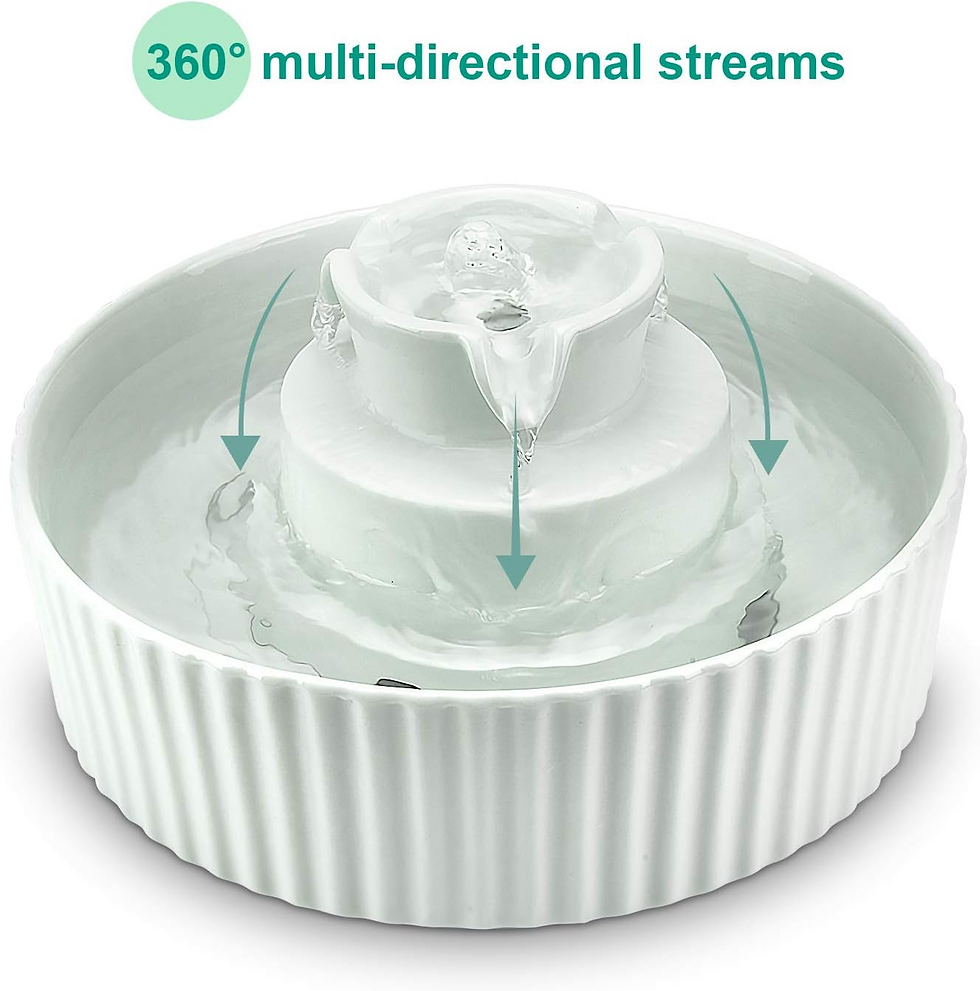
Of the fountains I've tried, this was probably my preferred one. I liked that it was sturdy, and the walls kept my splishy-splashy cat from tossing out too much water. I also felt like the filter and pump on this one was easier to clean. That said, the entire thing had to be cleaned in the sink by hand, and there are more curves/little spots to pay attention to.
This (below) was the runner-up, which the cats may have actually preferred. It was easier to clean, and I think the cats liked the arched fountain of water versus the straight-up fountain above. However, I hated refilling this one. There was no way to see how much water was left in the reservoir below, so I only knew it needed more water when the pump started making annoying sounds, which was probably bad for the motor. You're supposed to add more water by taking off the lid/top section, but there is no proper handle—you pull on the little silicone tab, which is part of the white fountainhead. Not only is this difficult because it's wet/slippery, but the lid/top section of the fountain is fit snugly into the base, and you had to pull surprisingly hard. I would try to refill by just pouring water on top and letting it cycle into the bottom, but the top is too shallow for that, and I would end up spilling water everywhere.

As for automatic feeders, I don't have much experience. I've been lucky to have cats that are pretty good self-regulators and don't eat too much. I also work from home, so I can feed my cats as needed. That said, I do think automatic feeders are a good idea in general. I would go for one that's actually automatic, rather than a gravity feeder (mostly because I would think the extra food would start going stale).
A note on water: it's incredibly important to make sure your cats stay hydrated. Cats originated in desert climates; water sources were less frequent, so they adapted to rely less on drinking water and more on the moisture content of their prey. Now that they're domesticated, they may need some encouragement to drink water more often. One reason fountains are good is because they incorporate running water as opposed to still water. Cats may prefer running water, as if from a stream, rather than still water, which might be dirtier. They might also like that running water is often a cooler temperature; you could also try placing ice cubes in your cat's water bowl to see if they prefer it. You might also place your cat's water bowl away from their food bowl (because in nature, they would not want their dead prey contaminating their water). Most cats aren't that picky, but these are good things to know.
Food
There are hundreds of pet food brands and styles, and there isn't a "wrong" answer, so long as you are informed and doing your best for your cat. When looking at cat food, it's ideal for protein to be the first ingredient. You'll also want minimal filler ingredients (corn meal and grains that don't add nutritional value and can lead to digestive issues). Take a look at the list of ingredients whenever you are pet food shopping; a lot of prestige brands (like Blue Buffalo, for one) have ingredients that I don't prefer. If you want to know, my cats are about 50/50 kibble and wet food. We get pretty middling brands; we get IAMS kibble, which does have more fillers than I would like, but it's decent and all of our cats seem to agree on it. Our wet food is our local store-brand (Meijer), which in my opinion out-performs a lot of the more expensive brands (when it comes to 3 oz cans—more on that in a bit).
Wet food
As I mentioned, cats used to rely on the moisture content in their prey in order to stay hydrated. Now that most cats have had their diets replaced with kibble, they are more likely to be underhydrated. The best way to alleviate this is to give them wet food. You don't have to switch to a 100% wet food diet, you don't have to get expensive refrigerated "fresh" food, but giving them a partial wet food diet is a good way to get them more moisture content, and they'll probably be pretty happy about it.
The two main things I look for in a wet food are 1) protein as the first ingredient and 2) no carrageenan. Carrageenan is a thickening agent often used in wet food. There is debate on whether carrageenan is safe or not. People food uses a "food-grade," more refined carrageenan. Many cat foods do as well. Some cat foods use a "degraded" carrageenan which is linked to bloat and gut issues, as well as cancer. Out of an abundance of caution, some cat owners choose to look for carrageenan-free foods; the good news is that there are lots of options. Many brands will tell you on the can that they are carrageenan-free. But if you read all of the labels, you can find carrageenan-free options among some of the cheapest brands—you'll just have to check each flavor/recipe individually. My local store-brand does not claim itself to be carrageenan-free, but it is.*
*A note on ingredients: it's good to get in the habit of checking your cat food's ingredients list periodically, because sometimes the formula changes (usually as a cost-cutting measure). There will also sometimes be discrepancies between the same brand, same flavors, but different sizes. For example, my local store-brand sells some pretty good stuff in 3 oz cans, but they also offer 5.5 oz cans that are less expensive. The trade-off is a worse list of ingredients, even though the marketing and packaging is exactly the same (at first glance).

At the end of the day, multiple things can be true; giving your cat some wet food (even the cheapest stuff with the least-impressive ingredients) is probably better than giving them no wet food. If kibble is all that is within your means, that doesn't make you less of a pet owner.
As an aside, if you're interested in making your own cat food from scratch, make sure you do a lot of research. It's not as simple as prepping the meats/vegetables/etc. Cats have a lot of specific needs when it comes to vitamins and minerals. You will need to get lots of supplements and do the math. For me, that's way too intimidating, so I'm leaving it up to the veterinary knowledge of the people coming up with pet food formulas.
Food bowls
There's not a ton to say about food and water bowls, but there's not nothing to say. First of all, there's the material. The preferred material for food and water bowls is stainless steel, followed by ceramic, then plastic. Stainless steel is the least porous and will therefore harbor the fewest germs. It's also easier to clean, and you know it will be dishwasher safe. Keeping clean dishes is especially important for my oldest cat, who is extremely prone to feline acne (black spots on the chin).

There's also bowl placement. As I mentioned earlier, your cat might prefer to have their food and water bowls separated. You should also probably keep both food and water bowls away from their litter boxes. You also might consider using raised/tilted bowls. These are more often used for dogs, but supposedly having raised bowls helps with digestion and reduces vomiting. I got a bowl stand when our middle cat went on a vomiting spree. Did it help? I'm not sure. But I like it aesthetically, so I guess that's a win. This stand also fits lots of bowls, so you can swap them out frequently without waiting to wash them (I use some plain white bowls from IKEA, which fit great).
A note on whisker fatigue: some cats, particularly as they age, can have sensitive whiskers. They won't like deep bowls that bump their whiskers when they eat. Generally, a shallow bowl or saucer is best. If you end up with a collection of bowls and saucers, your cat(s) will let you know which ones they like best (or more accurately, which ones they don't like)—we have some saucers with an adorable sushi print on them, but the cats will never finish the food on these. They either don't like the roundedness inside the saucer, or the specific ceramic glaze.
Puzzle feeders
Puzzle feeders are great if your cat is not great at self-regulating their kibble and eats too much. They're great if your cat is not great at pacing themselves and eats too fast, making themselves throw up. They're great as a treat distribution system, regardless of kibble habits. Different cats will excel at different kinds of puzzle feeders; some puzzles will be advertised by difficulty ranking, so you can find something for your cat whether they're a safe-cracking trickster or if they never did get to take their turn with the brain cell.

We've got three puzzle feeders, with varying degrees of "puzzlement." Each one is preferred by a different cat. The simplest (and cutest) is this one here. This style is just a fabric mat with lots of nooks and crannies to hide treats in. They'll forage for treats, another great method for environmental enrichment. This toy is preferred by our oldest cat, who likes a more gentle and easy method of play.

The next-easiest feeder is the standard treat ball. You load it up with kibble and/or treats. They bat it around until pieces fall out of the holes. This one is marketed for dogs, but it works great for us. When looking at feeders designed for dogs, look for measurements or reviews confirming that the holes will work for small, cat-sized pieces (otherwise they'll just fall out and won't present a challenge). Our youngest cat prefers this feeder, because it combines treats with play (and the following option is still a bit difficult for her).
The most difficult feeder we have is truly a puzzle. The cats have to move swiveling, rotating, and sliding pieces in order to access the treats. This one is preferred by our middle cat. I think he likes the puzzle/foraging aspect (versus the ball), and he definitely likes that the youngest cat isn't very good at it yet (more treats for him). I like that this has a larger capacity, and the design is also cute.

A note on DIY puzzle feeders: before I ever bought a puzzle feeder, I made one for free. I took a plastic soda bottle, washed and dried it, and cut two small holes in it (one on either side, at different heights). That's it. I loaded it with kibble, screwed the cap on, and set it on the floor. My cat learned to nudge and roll the bottle until treats came out.
Health
Another reminder that I'm not a vet! I'm just a lifelong cat owner who catastrophizes and likes to be prepared. I won't get into stuff like first-aid kits (I just have a household one, and I live right next to our veterinarian). You should think about stuff like that, look up which household plants are toxic, so on and so forth. You should know the phone number and address of your nearest 24/7 animal hospital.
The following is just a very short list of things that have come to mind, in no particular order...
Soft cone
When your cat has a surgery or has any sort of wound/incision/etc. that they aren't supposed to touch, your vet will give them one of those plastic cones, also known as an Elizabethan collar, E cone, or recovery cone. Cats hate them; aside from being a strange object in their peripheral vision, they're also prone to bumping into things, not being able to lie down comfortably, or getting poked by plastic. I had a hell of a time getting plastic cones to stay on my cats. The latest one we got from the vet only had two size settings, and my cat was too small for it. I bought a different plastic cone with adjustable Velcro for a custom fit, but that one also wouldn't stay on for long. A soft cone has been a game-changer.

What I love about this is that the "cone" goes down, not up. Their vision isn't obscured, and they were immediately much less bothered. They weren't bumping into walls, couches, or the litter box. They could lie down comfortably—very comfortably, with a built-in pillow! The fit is also much better, assuming your cat's injury/incision isn't on their face or neck. This is an enclosed circle you slide over your cat's head. There is a drawstring to tighten until the fit is safe but snug. My cat only managed to pull the cone off one time over about a week and a half. Plus, look out how cute it is!


A note on collar tightness: any collar you put on your cat should be snug but not tight. You should be able to fit two fingers under their collar. All regular collars (not Elizabethan collars) should be break-away, so if your cat were to get outside and get their collar snagged on a fence or branch, the collar would not choke them or keep them trapped.
Non-scented litter
For most cats, this might not be a medical thing, but my oldest cat has asthma and is also prone to the sniffles. In general, cats might not particularly like scented litter. Their noses are sensitive, and we're asking them to stand in a box of strongly-scented stuff. You might want to try out non-scented litter to see if your cat prefers it. For cats like mine, giving them something that's less likely to irritate their lungs and throat is important.
This is all relative. Your cat might not care. You can probably be flexible; we currently have a litter box in our bedroom, so that box needs to have moderately-scented litter (for my own sanity). Another thing to consider alongside the scent of litter is the dustiness of litter. Lots of litters claim to be low-dust, but that isn't always so. Again, this matters more for certain cats than others.

Something that will help you when it comes to litter box smell and dust is an air purifier. Putting a small, cheap air purifier next to the litter box in the bedroom has made all the difference for us. More than any scented litter, more than any baking soda is the waste tray, more than any odor absorbers (which I also use), more than frequent scooping, the air purifier has done the most for keeping the air fresh.
A note on litter box issues: cats might be having litter box issues (going outside of the box) for any number of reasons. Definitely consult your veterinarian, but once you rule out health issues, there's still lots to try. Your cat might not like the scent of the litter, or the size/material. You might try placing the litter box in different locations, ideally lower traffic zones where they can feel some privacy. Some cats don't want to be placed in a corner, where they could be trapped and vulnerable. If they're just being picky, or need a little reminder on where to go, some litter attractant can be useful.
Carriers
Pet carriers deserve a fair amount of thought. If you have multiple cats, you should ideally have enough carriers to get everybody safely into the car if necessary. Depending on the kind of travel you're doing, you might want a carrier with some physical flexibility (a soft/fabric carrier), or the kind of carrier that can expand to fit food bowls, etc.

I much prefer hard carriers. Cats can't scratch them up, they're easier to clean, and I feel like they give my cats more privacy. I only ever travel with them in the car, so a slightly bulkier carrier is no problem for me. I really like this carrier, and I've got two of them (our third carrier is a soft carrier that was gifted to me). I find it easier to load the cats into the top door, rather than try to shove them through the front. The top door won't stay propped open by itself, but if you rest the carrier against a couch or table, tilted at 45 degrees, gravity will keep it open. I usually put a towel inside so the cats can be a bit comfier. I also bring a little throw blanket (a flimsy thing from Five Below) and keep it draped overtop while we're waiting in the lobby at the vet's office; it gives them some extra privacy and reduces anxiety (anything to help!), and it also gives them a familiar smell.
A note on travel: buckle up in the car! Your carrier probably has a way to thread the seat belt through a handle or strap. If not, there are adapters for that online. If your cat often throws up in the car, it can help to cover the sides and top of their carrier with a blanket, leaving only the forward-facing view; this can help with motion sickness. You can also experiment with calming drops/chews/etc. You can also ask your veterinarian about a prescription for Gabapentin. I've got a houseful of anxious cats, and they all get a dose of Gaba before each vet visit (you might ask for a dose before any upcoming major move/road trip).
Manual litter boxes
I actually do have a favorite manual litter box, which I've ordered multiple times and used across multiple cats. After getting automatic litter boxes, this one has been my backup box in the basement for when I need to quarantine cats.
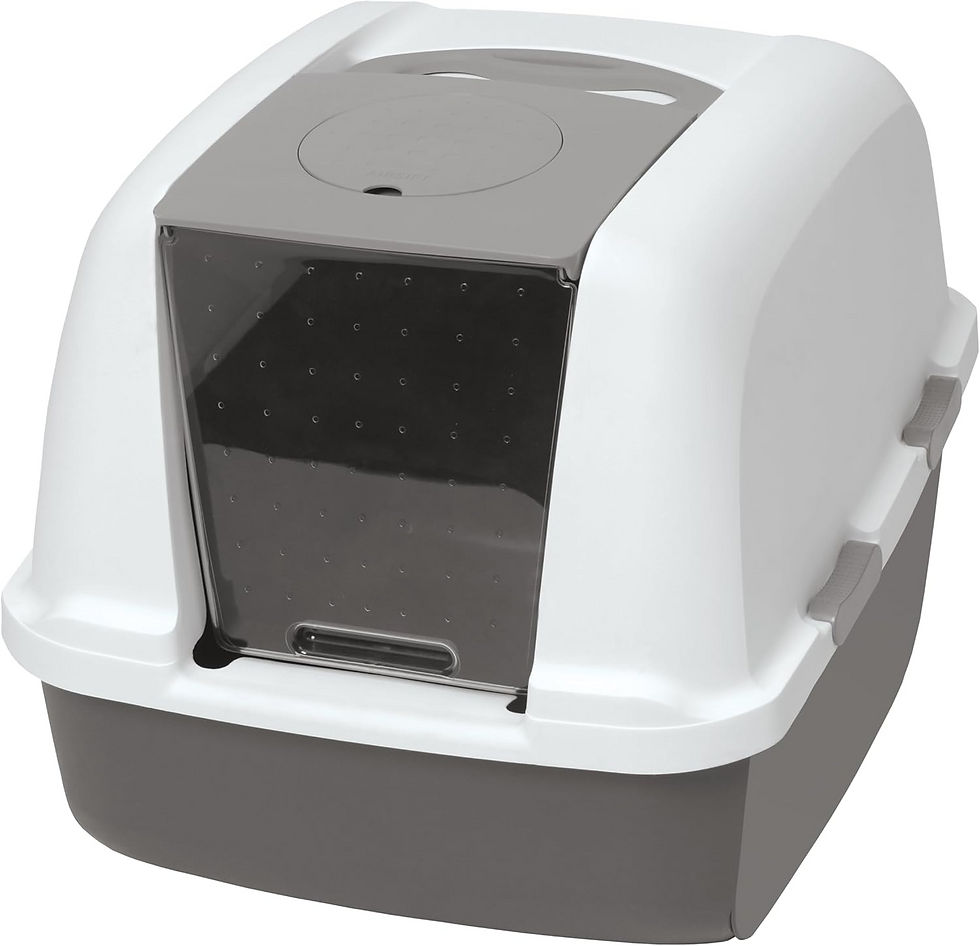
I like that it's big, sturdy, and very difficult to get mess outside of. You can take the plastic entry flap off entirely, or flip it up so it rests on top (at least in older versions). I kept the entryway open, because it's more intuitive for the cats, and I didn't want them to be trapped with smells (as someone who's bad at doing the litter).

I also got another litter box when we found a tiny kitten. The other litter boxes were big, and I wanted to grab something quickly (without thinking too hard) that I knew would work. A low-entry pan worked great, and came back in doubly important when we got her spayed; something like this will help with small cats, old cats, and post-surgery cats.
There are tons of different litter box styles, so you can find something whether your cat wants more privacy, less privacy, sprays, kicks litter, or has limited mobility.
Spay and neuter and stay indoors
This probably goes without saying. Spaying/neutering is a part of responsible pet ownership. It can be expensive, but there are lots of clinics that will host spay/neuter events at greatly reduced cost. And having your cat spayed/neutered is especially important if they ever get outside.
That said, you should really consider keeping your cat indoors. It's so much safer. Even if you don't have a lot of vehicle traffic, there will always be other animals outside that can hurt your cat. Cats are also harmful to local bird populations. All in all, it's better for everyone if your cat remains inside. It's up to you to provide environmental enrichment and give them a happy life indoors.

A note on TNR: if you plan on letting your cat(s) outside, spaying/neutering becomes even more essential. Even if you keep your cats inside, if you're interested in learning more about helping out the feral cats in your area, look up TNR—Trap, Neuter, Return (otherwise known as Trap, Neuter, Release, but it's important to return the cat to its original location). Many vet clinics will help you spay/neuter feral cats for a low cost. A spayed/neutered cat will have its ear (humanely) tipped so that vets and caretakers of feral cat colonies will know. Tipped ears are a sign to help these cats avoid unnecessary trapping and surgeries.
Toys
Now for some great toys that aren't automatic. Each cat will have their preference, but here are some toy styles that have consistently been popular in our household.
Wire
It sounds so simple. And it is! Some paper on a piece of wire. Our cats all love this toy more than any "wand" toy. The tension and wobbly nature of the wire is more enticing than a more traditional string. It has a good bounce when they bat at it. The paper rolls can slide along the length of the wire, so I can evenly distribute them on each side, hold the wire in the middle, and get a cat playing with each side of this. The wire is slightly curved (it comes rolled up in a circle); our youngest cat will sometimes play with this all by herself, holding one end in her mouth and chasing the other end around in circles.

A note on traditional wands with feathers and strings: cat toys with feathers and strings can be a choking hazard or cause intestinal issues. Feathers will easily get pulled off or shed, getting ingested by your cat. You'll just want to observe your cat's behaviors with these toys and make sure they aren't getting into trouble. With a lot of cheap toys that come with feathers/strings attached, you can easily yank or cut them off and still have the base of the toy. The wire toy is nice because the paper is safer. Just double check each end of the wire to make sure there is nothing pokey (so far, they've all been totally safe!).
Springs
Our cats LOVE springs. For some reason they aren't in most pet toy sections, but you can easily find them online. They're made of a sturdy plastic, and they've got a great bounce to them if you're tossing them over wood or tile (they'll roll nicely over carpet as well). Our youngest cat plays fetch with these for as long as we will keep throwing them for her. If you hold them between your thumb and forefinger and scrunch them up and down a couple of times, giving 'em a good clickity-clackity, the cats will activate like sleeper agents.

A note on durability: the ones I've linked have been nice and durable, but any/all springs will sometimes break. Be sure to throw away any springs that break and could be choking hazards or have overly pokey plastic. If you check out other brands, be sure to look at the reviews, because certain brands use thinner and less durable plastic.
Kickers
Kicker toys can vary in size and shape, but they're essentially larger, longer toys that your cat can grab onto with their front legs and then "bunny kick" using their back legs. Most kickers will have catnip or silver vine inside. This is something that would be easy to make, if you know how to sew. If you look online, be sure to look at the reviews to see if the kicker is actually big enough for your cat to kick—a lot of "kickers" are too small for this intended purpose. Handmade kicker toys seem to be more appropriately sized. Our best kicker was made by a local shelter as a fundraising item.

A note on keeping toys interesting: any toy filled with catnip will eventually lose its zest. To keep cats interested in their toys for longer, you can 1) rotate their toys out and 2) "marinate" them in catnip to get them nice and smelly again.
Cute stuff

There's nothing wrong with picking some toys for the aesthetic. Most cat owners end up with more toys than their cats need (all the more reason to rotate their toy supply), but that doesn't mean you shouldn't grab the cute catnip toys that look like pizza or sushi. One of my personal favorites has a really short backstory: Mr. Greene and I were in the car, driving home, and I was hungry. I told him, "If only the cat had a cell phone, then I could call her and tell her to preheat the oven." So I got her a cell phone.
Miscellaneous
Below are some more miscellaneous categories and some final thoughts. Once more, in no particular order...
Grooming

Cats are pretty good at grooming themselves, but your cat might need more or less accommodation. Most cats will benefit from some brushing. Most cats can get away without needing baths, but if your cat has a special coat or health consideration, be sure to look into it.
I like a brush that can reach a cat's undercoat. Cheap brushes with flimsy plastic bristles don't do much, in my opinion. Using a brush with fine teeth, meant for de-shedding, will get better results. If you're gentle and take your time, cats are much more likely to enjoy being brushed.

In addition to brushing, dander wipes are a great way to help clean your cat. These are especially useful for senior cats and overweight cats, who might have a harder time reaching their back. My oldest cat is prone to dandruff and grease on her lower back and above her tail. She likes to get wiped down; we make a whole routine of it, crinkling the bag of wipes before we begin. I just lay the wipe in my palm and pet her gently as normal. Then I use my fingertips to sort of massage the wipe into her fur. She loves it, and she definitely feels cleaner afterward.

As I mentioned earlier, my oldest is also prone to acne on her chin. Keeping clean dishes helps, but not completely. I also use chlorhexidine wipes on her chin. These are also good for minor scrapes and irritations, so they've come in handy. The smell is medicinal but not obnoxious. For my purposes, these are larger than I need them to be, so I cut them in half, and they've lasted me a long time. I do these wipes before the dander wipes (she really loves those, so they're like the treat afterward). I sit with her between my legs, facing away from me. I put one hand around her, on her chest, to hold her still. With the other hand, I fold the wipe in half (at this point, it's gone from circle to half-circle to quarter-circle) and gently rub it back and forth against her chin. If you keep this calm and gentle, it's just a nice chin rub. Then I fold the wipe the other way, to the clean side, and rub again. It all takes less than 30 seconds.

A note on hair around the house: shedding fur is inevitable. Aside from vacuuming and using a lint roller, I'm also a fan of the fur removal tool. This is great for running over couches, pet beds, cat trees, etc. The amount of hair that comes up is pretty shocking.
Scratch-resisting your home
The best way to avoid having your cats scratch up all of your furniture is to provide them with other places to scratch. A simple scratching post will do—placing them throughout the house, in front of the places you don't want them to scratch, will help redirect their energy. If there is something small and moveable that they've already scratched up (most likely an ottoman/footstool) you can try offering that up as the sacrificial scratching surface.
Your cat trees will probably come equipped with scratching posts. If you'd like some suggestions on cat trees, check out that section above! Having more of them and placing them strategically will help.

Another great option will be cardboard scratchers. These are relatively inexpensive, often come in a multipack, and can be moved around easily. The cardboard inserts are often sold in the pet section of stores. Once the cardboard surface has been thoroughly scratched up, you can reverse the board to use the other side, so they last a while.
You can also cover your furniture with anti-scratch plastic. This has performed well for us. The plastic is sufficiently thick, and their claws just slip right off. Even more than the couch, I've found these great for sticking on the carpet under doors and in front of our pet gate to prevent the cats from picking up the carpet.

Of course, you can try to teach your cats that they shouldn't be picking at carpet and scratching the sofa. They may or may not be receptive to you. In addition to training, you can always try to get out their energy with play and entertainment. Using cat toys and providing environmental enrichment can help to partially eliminate behaviors like scratching.
A note on scent marking: as I mentioned with cat trees, part of the reason cats scratch is to leave their scent behind. Putting cat trees, scratchers, and pet beds around the house will distribute their scent and leave them feeling confident about their territory.
Pet gates
It's tricky to keep cats relegated to certain parts of the house. Most pet gates are easy for cats to jump over. Most likely, you'll need a gate that is exceptionally tall.

I've really liked this one. It was relatively easy to set up, once I knew what I was doing. Like most pet gates, it's held in place by tension. The main gate is 4.6 ft high, which will be sufficient for many cats. To my surprise, the cat that finally jumped it was our old feral, who was large and heavy (improbably agile!). No problem—it comes with a height extender you can add to the top, bringing the total height to about 6 ft. Since then, no one's been able to (or even attempted to) make the jump. There is a little square opening at the bottom that you can open up if you ever want to allow cats through but keep out larger dogs. I like that the latch on the gate just lifts up and down (there's no lever mechanism, button you need to press, or pinch/squeeze to open). There's a little ramp at the bottom of the gate, which gives it some stabilization and makes it easy to push a vacuum over.
I did learn that we have to lock the gate at night; our cats learned that they could paw and pull at the gate bars, which would make the whole thing rattle. Not only was that annoying, but they even managed to rattle the gate so hard that the latch shimmied up and opened the door. If you lock the gate (a little metal tab above the latch swivels down and prevents the latch from being lifted), the door can't be opened, and it prevents the whole gate from rattling so much.
Why might you want a gate? For us, the main purpose it to keep our cats separated. Our oldest cat is afraid of other cats. She's been a trooper over the years, but we finally decided that we should divide the house so that she can have her own dedicated space without needing to be hypervigilant. It's been such a quality of life improvement for her, and she's thriving!
A gate like this will also be great next time we introduce a new cat to the house. Rather than tossing a new cat into the mix, it's best to introduce them to each other slowly. Usually, you give the cat at least one day fully quarantined in one room. They can get used to you, the smells, and stake some claim in this corner of the house, establishing their own scent markers (it would be stressful to get dropped into a house that smells like other cats' territory around every corner!). Then you give them at least one day of interacting with the other cats via smell and—if the vibes are good—sight. First you would give them each other's beds or other scent markers so they can get a good sniff. You're letting them know who else is in the house and will be sharing the space. When they're ready to meet each other, a gate will ensure that no one's boundaries are crossed; they can sniff each other, maybe even bat at each other, but no one will get pounced on, and they have the freedom to retreat if they want to. The timelines can vary a lot (some people recommend at least one week), but a smooth introduction can help start everybody out as friends, rather than threats.
Routines
Cats care more about their routine than you might think (if you're already feeding them wet food, you probably already know this!). You might not be able to feed them at the same time every day, but there are other ways you can establish routines for your cat.
For example, every day, when Mr. Greene is getting ready for work, he spends a few minutes with each cat. The oldest cat knows to hop up on the bed and spend a minute wrestling with him. The middle cat hops up on the cat tree for some kisses. The youngest mostly just runs around, stopping a few times for pets. Every day, they know what time it is, and they assume their positions. At bedtime, the oldest cat is up on the bed again. We do some more wrestling. She and I do our grooming routine. Then she's on my lap for the next 30 minutes or so.

Finding ways to incorporate your cat(s) into your routine at the same time each day is not only good bonding time, but it's grounding for them. And sometimes it can be silly or frivolous—every December, we like to include our cats in the holiday festivities by opening up an advent calendar with them each day. Fancy Feast usually does one with a variety of wet food and treats, but they can be hard to find at our local stores. Last year we were gifted an advent calendar full of toys, which was fun, but a lot of the toys didn't pass our safety test (needed the feathers and strings removed, plastic was too flimsy/breakable, etc.). You could even create your own calendar if you were so inclined.
A note on finding what works: even our feral cat had preferences—he might not have let us pet him, but he liked to sit beneath my chair. He had his own routine, types of bedding he preferred, and times of day when he would make the rounds. He preferred catnip over chicken treats. My point is, even if you have an aloof cat, if you're patient and observant, you can pick up on what works best for them.
≽^•⩊•^≼
Well!
That's about all I've got for now. Thanks for checking out my numerous and rather specific cat opinions. Thanks for loving your cat.
Do you have any other insights or cool suggestions? Let me know!
Sage T. Green, Author


Comments